
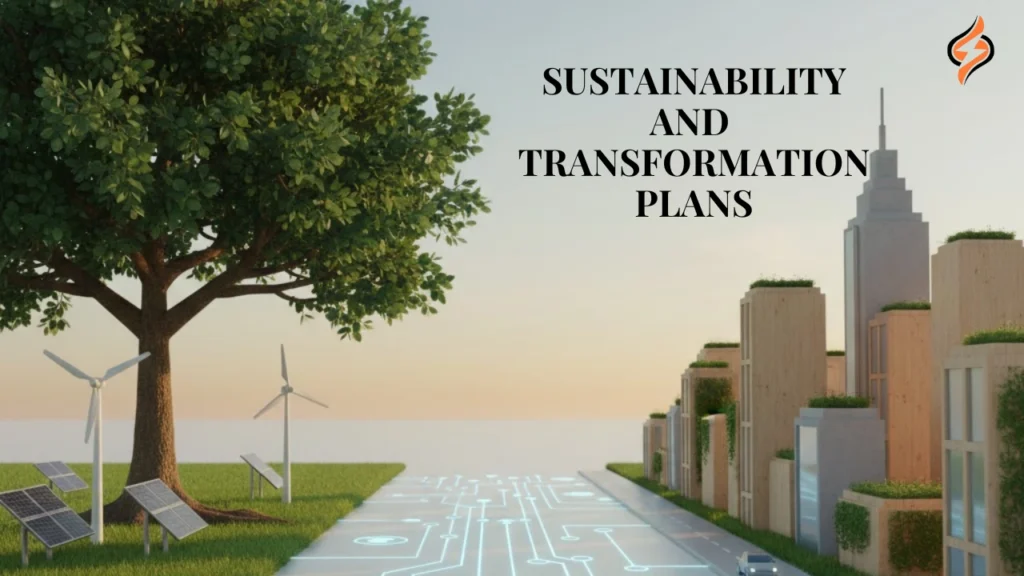
The global conversation around sustainability has shifted dramatically in recent years. Early efforts focused on incremental improvements like recycling or energy efficiency. Those actions raised awareness, but they did not alter the underlying systems that create environmental and social challenges. Today’s reality is that systemic problems such as climate instability, natural resource depletion, and inequality cannot be addressed through isolated actions alone. This recognition has given rise to sustainability and transformation plans.
These plans link sustainability goals with comprehensive, long-term change. These plans are increasingly central to how organizations and institutions manage risk, resilience, and long-term value creation.
This article explains what sustainability and transformation plans are, why they matter, how they are built, and where they are being applied.
The Limits of Traditional Sustainability Approaches
Traditional sustainability strategies focus on minimizing negative impacts. Organizations work to reduce emissions, cut waste, and improve energy efficiency.
While important, these actions often occur within existing operational and economic systems that remain unchanged.
When the underlying system does not shift, efficiency gains can be offset by growth in activity.
For example, cleaner production processes may still depend on unsustainable supply chains, and reduced energy use may be offset by higher production volumes.
This inherently limits the effectiveness of sustainability actions that do not involve structural change.
The need for deeper change is one reason why many companies have adopted broader transformation planning.
According to Recent research, around 64% of global companies report having a transition plan, yet only a small fraction demonstrate strong progress in developing or disclosing actionable steps toward those plans.
You May Also Read: Generative Tourism: Why Sustainable Travel Is No Longer Enough
What Transformation Means in Practice
Transformation refers to fundamental redesign, not just refinement. It changes how systems function rather than simply optimizing individual parts.
In sustainability contexts, transformation includes shifts such as:
- Moving from linear to circular material flows.
- Replacing fossil-dependent energy systems with renewable-based systems.
- Redefining economic value to include environmental and social outcomes.
Transformation is broader than improving a process; it reshapes how resources, incentives, and decision-making structures operate across entire systems.
This systemic redesign is essential for turning sustainability intentions into measurable and long-term impact.
You May Also Read: Sustainability and Transformation Plans: Beyond Greenwashing
What Is a Sustainability and Transformation Plan?
A sustainability and transformation plan is a strategic roadmap. It outlines how an organization, government, or system will transition from its current state to a future state that is ecologically sustainable, socially equitable, and economically resilient.
These plans integrate sustainability objectives with specific actions and timelines.
They clarify what changes must occur, why they are needed, and how progress will be achieved over time.
A strong plan links ambition with operational reality, balancing long-term vision with actionable steps.
In practical terms, a sustainability and transformation plan answers one central question:
How can a system be redesigned to operate within environmental limits while supporting human needs?
What These Plans Are Designed to Achieve
Sustainability and transformation plans pursue interconnected outcomes:
- Environmental resilience: reducing the ecological footprint to sustainable levels.
- Social equity: ensuring fair access to resources and opportunities.
- Economic durability: balancing profitability with long-term sustainability.
- Governance clarity: aligning decision-making systems with long-term goals.
Unlike incremental strategies, these plans address root causes, not just symptoms.
How Sustainability and Transformation Plans Are Built
Although details differ by context, high-quality plans share a common architecture:
1. Vision and Long-Term Direction
A clear vision paints the picture of a sustainable future.
2. Baseline and Impact Understanding
This phase maps current impacts, dependencies, and system behavior.
3. Targets and Commitments
Effective plans set science-aligned targets. Over 10,000 companies worldwide have science-based climate targets validated by the Science Based Targets initiative (SBTi), demonstrating widespread uptake of measurable commitments.
4. Strategic Pathways
Pathways describe the major levers of change, such as innovation, sourcing transformation, and business model evolution.
5. Roadmap and Phasing
Roadmaps sequence actions over time, linking short-term activities with long-term objectives.
6. Execution and Governance
These plans assign roles, responsibilities, and budgets to ensure implementation.
7. Measurement and Feedback
Key performance indicators and feedback loops enable learning and course correction.
You May Also Read: How to Balance Cost and Sustainability in Coffee Packaging
The Major Domains of Sustainability and Transformation Plans
Sustainability and transformation planning is now applied across multiple domains. Each represents a critical part of how systems operate:
#1 Business and Organizations
Companies redesign products, operations, and supply chains to align with sustainability goals.
Strategic planning within businesses now increasingly includes transformation components that integrate sustainability into core strategy.
#2 Finance and Investment
Financial systems are transforming how risk is evaluated and capital is allocated. Investors use transition plans to understand long-term climate risks and opportunities, integrating sustainability into decision processes.
#3 Cities and Governments
Urban systems transform infrastructure, mobility, housing, energy, and waste systems to support sustainable and resilient communities.
#4 Energy Systems
Energy transformation plans focus on deploying renewables, modernizing grids, and integrating storage to shift away from fossil fuel dependence.
#5 Built Environment
Buildings evolve toward low-carbon materials, high efficiency, and lifecycle sustainability approaches.
You May Also Read: Sustainable Marina Design: Building Eco-Friendly and Resilient Harbors
#6 Supply Chains
Supply chain transformation addresses sourcing, logistics, and circularity to reduce hidden emissions and resource pressure.
#7 Technology and Digital Systems
Digital tools, data platforms, and scenario modeling enable dynamic planning and system monitoring.
#8 Personal and Lifestyle Systems
Individuals increasingly adopt personal transformation plans to align lifestyle choices with sustainable values.
Each domain functions within a broader web of interdependencies, shaping how transformation unfolds across sectors.
You May Also Read: Sustainability Trends in Golf Courses: Innovations Shaping the Sport
How These Domains Interconnect
No domain evolves in isolation. For example, business transformation relies on energy transition, and energy transition relies on finance.
Sustainability and transformation plans recognize these interdependencies and coordinate actions across sectors to avoid shifting problems from one area to another.
This systems perspective distinguishes transformation planning from isolated sustainability initiatives.
You May Also Read: Eco-Friendly Technologies for Sustainable Living
What Distinguishes Strong Plans from Weak Ones
High-quality plans are specific, time-bound, and resourced. They integrate sustainability into core strategy rather than treating it as a peripheral program. They include mechanisms for accountability and transparent reporting.
The 2025 EY Global Climate Action Barometer finds that while many companies claim to have transition plans, only a minority demonstrate actionable progress aligned with climate science recommendations.
In contrast, weak plans rely on generic language, lack measurable targets, or do not connect to operational decision-making.
These superficial approaches can create the illusion of progress without delivering systemic change.
Why Transformation Planning Is Becoming Continuous
Conditions change rapidly.
Technologies evolve, risks intensify, and societal expectations shift.
For these reasons, sustainability and transformation planning are increasingly treated as a continuous process rather than a one-time project.
Plans evolve based on new data, insights, and emerging risks.
This reflects a broader shift toward adaptive management and strategic resilience.
You May Also Read: Every Prompt Has a Price: The Hidden Environmental Cost of Generative AI
How to Navigate This Ecosystem
Different audiences engage with transformation planning from different perspectives:
- Business leaders focus on organizational transformation.
- Investors focus on capital allocation and risk.
- City planners focus on infrastructure and resilience.
- Individuals focus on lifestyle and consumption patterns.
You May Also Read: Sustainable Jewelry: The Complete Guide to Ethical and Eco-Friendly Choices
Final Synthesis
Sustainability sets the goals, and transformation delivers the path to reach them. Sustainability and transformation plans bridge that gap by aligning vision, structure, and execution.
They represent a shift from treating sustainability as a stand-alone objective to embedding it within system design and strategic decision-making.
This shift is shaping the future of organizations, cities, and societies.