
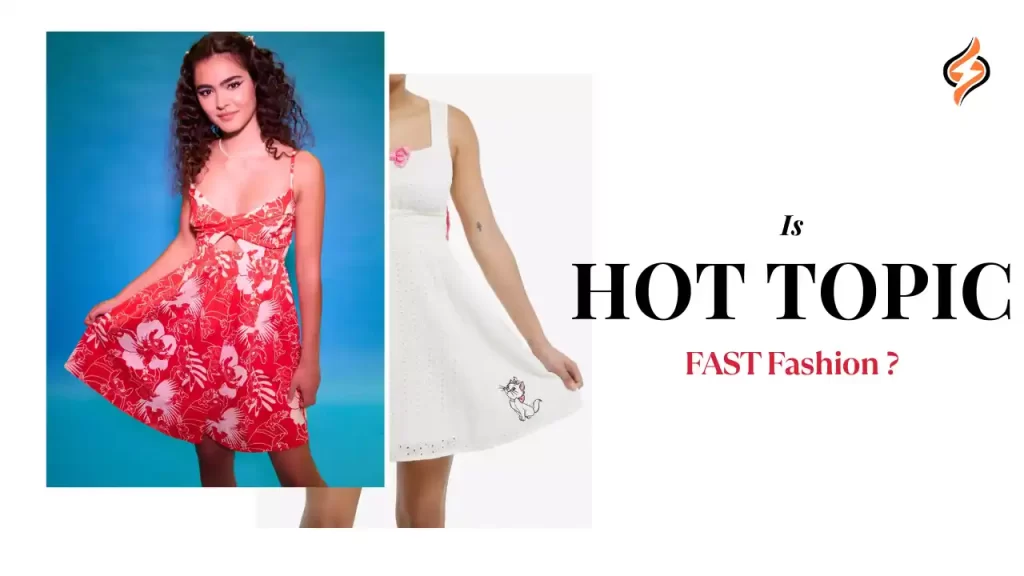
Hot Topic – known for its band tees, pop culture merchandise, and goth/emo-inspired apparel – markets itself as a hub for counterculture fashion. But behind the edgy aesthetic, is Hot Topic fast fashion?
Fast fashion is characterized by rapid production of trendy, low-quality garments that encourage frequent purchases, often at the expense of ethical labor practices and the environment.
Below, we examine all aspects of Hot Topic’s business model, sustainability (or lack thereof), and ethical footprint to determine if it fits the fast fashion label.
Business Model & Trend-Driven Merchandise
Hot Topic has grown to about 700 stores across the United States, selling music and pop culture-inspired clothing and accessories.
The company’s success hinges on constantly stocking the latest band merchandise, anime and gaming apparel, and trendy alternative styles.
This “of-the-moment” product strategy aligns with fast fashion’s emphasis on quickly mass-producing what’s currently popular.
As tastes shift from goth rock bands of the 80s/90s to K-pop and anime today, Hot Topic rapidly adapts its inventory to new fads in order to “provide things that will make them money,” as one commentator noted.
This frequent turnaround of styles incentivizes customers to buy repeatedly (overconsumption), a hallmark of fast fashion.
Notably, Hot Topic is owned by private equity firm Sycamore Partners, indicating a focus on profitability and growth.
The brand expanded with spin-off ventures like Torrid (plus-size alternative fashion) and has shifted over decades from niche goth merchandise to more mainstream pop-culture items.
While this evolution kept the business trendy, it also suggests that Hot Topic embraces the same core model as other fast fashion retailers – chasing microtrends and youth culture to drive sales, rather than sticking to timeless or high-quality designs.
You May Also Read: 9 Best Thrift Stores Seattle: Your Guide to Finding Hidden Treasures & Saving Money
Lack of Sustainability Initiatives
One glaring sign of Hot Topic’s fast fashion status is its complete lack of public sustainability commitments.
Unlike more responsible brands, Hot Topic does not even have a “Sustainability” page on its website, offering no transparency about environmental or ethical initiatives.
This absence “shows how little it cares about the planet and its environmental impact,” according to sustainability experts.
You May Also Read: Is Aritzia Fast Fashion? A Comprehensive Analysis
In fact, independent ethical fashion reviewers have consistently rated Hot Topic at the very bottom for sustainability:
- Good On You (an ethical brand rating platform) gives Hot Topic an overall rating of “We Avoid” (1 out of 5). The brand provides insufficient relevant information about how it reduces its impact on people, the planet, or animals. Good On You warns that consumers “have a right to know” how their purchases affect these issues, but Hot Topic offers virtually no data or policies to evaluate. (For context, Good On You’s scale runs from 1 = “We Avoid” to 5 = “Great,” and Hot Topic sits at the very bottom.)
- The Commons (Earth), another sustainability rating resource, likewise classifies Hot Topic as “Harmful”. It explicitly calls Hot Topic a fast fashion company that “exploits labor and natural resources while incentivizing overconsumption.”
- In Sustainably Chic’s 2025 list of “Worst Fast Fashion Brands to Avoid,” Hot Topic is listed among notorious fast fashion giants. The article flatly states “Hot Topic is a fast fashion brand” selling pop culture apparel in hundreds of stores.
In summary, Hot Topic has no published sustainability report, climate targets, or evidence of working to reduce environmental impact, which is typical of fast fashion retailers.
Environmental Impact: Materials and Waste
Another fast fashion red flag is Hot Topic’s heavy reliance on cheap, unsustainable materials.
The brand “primarily uses conventional cotton and synthetic fabrics such as polyester and acrylic for nearly all its clothing.”
You May Also Read: Fast Fashion Cheap Materials 10 Washes: The Shocking Truth
These materials have well-known environmental downsides:
- Conventional cotton is resource-intensive (high water usage and pesticide use), unless sourced organically. Hot Topic has not disclosed using organic cotton, so we assume standard cotton is used, with a larger environmental footprint.
- Synthetics like polyester and acrylic are derived from petroleum, require significant energy to produce, and are non-biodegradable – contributing to microplastic pollution when washed. Fast fashion brands favor these cheap materials, and Hot Topic appears no different.
Crucially, Hot Topic gives no information on efforts to use eco-friendly materials or reduce waste.
There’s no indication of recycling programs, sustainable collections, or goals to cut carbon emissions. In contrast, genuinely sustainable brands invest in things like organic fabrics, recycling initiatives, or durable design – none of which Hot Topic publicly does.
The fast fashion model inherently leads to overproduction and waste, as new trends replace old stock rapidly.
With Hot Topic constantly refreshing pop-culture styles, one can infer a significant turnover of inventory. Unsold or quickly discarded items likely contribute to textile waste streams, a problem exacerbated by the low durability of cheaply-made garments.
Without any transparency, we can only assume Hot Topic’s environmental impact is on par with similar retailers that generate high waste and pollution.
Labor and Ethical Practices
Ethical labor practices are another major aspect – fast fashion is often criticized for sourcing from factories with poor working conditions or poverty wages.
Hot Topic’s stance here is murky due to poor transparency. The company claims to require fair labor via its Supplier Code of Conduct (prohibiting forced labor, child labor, discrimination, unsafe conditions, etc.).
However, there is no public disclosure of supplier lists, factory locations, or independent audits to verify compliance.
Hot Topic does not share if its clothes are made in sweatshops or ethically-run factories – a lack of accountability common in fast fashion supply chains.
Importantly, Hot Topic’s pricing suggests that workers in the supply chain may be paid very little.
As one discussion noted, the brand’s low prices are “inconsistent with ethical pricing,” implying someone in the production process is likely being underpaid.
Without evidence of fair wage programs or certifications (e.g., Fair Trade, SA8000), it’s reasonable to assume Hot Topic sources from the same global factories as other fast fashion brands, where labor exploitation is a known issue.
In fact, The Commons Earth explicitly states that Hot Topic “exploits labor” as part of its fast fashion business model.
For animal welfare, Hot Topic similarly lacks policies, meaning Hot Topic hasn’t disclosed any cruelty-free measures or material sourcing standards.
The brand likely uses some animal-derived materials (leather, wool, etc.) in products without transparency on their origins or animal welfare. Again typical of fast fashion companies that don’t prioritize ethical sourcing.
You May Also Read: Is Commense Fast Fashion? An In-Depth Investigation
Transparency and Accountability
A critical aspect that separates fast fashion brands from responsible ones is transparency. Brands committed to sustainability usually publish detailed info about their supply chains, factory conditions, environmental impacts, and improvement targets.
Hot Topic, by contrast, is extremely opaque:
- No public reporting on its social or environmental impact.
- No information on factory monitoring or outcomes of any supplier audits. The code of conduct mentions allowing audits, but the results or adherence are never shared.
- No measurable goals (e.g. reducing carbon emissions, using X% sustainable materials by a date, etc.).
- No mention of worker empowerment or fair trade initiatives.
This lack of accountability led ethical reviewers to admonish Hot Topic. Good On You highlights that “you have a right to know how the products you buy affect the issues you care about,”. But Hot Topic provides insufficient information on all counts. Sustainably Chic also notes we “do not know whether [Hot Topic] does something to reduce its footprint” due to zero transparency.
In essence, Hot Topic operates in the shadows regarding ethics and sustainability, which is a hallmark of fast fashion retailers that “say almost nothing about sustainability”.
By doing so, they avoid accountability and can continue business-as-usual. This stands in stark contrast to truly sustainable brands that openly communicate progress and challenges. Hot Topic’s silence speaks volumes.
You May Also Read: Is Old Navy Fast Fashion or an Ethical Choice? Ethical and Environmental Impacts
Conclusion: Is Hot Topic as Fast Fashion
All evidence indicates that Hot Topic is indeed a fast fashion company. Even the brand’s own description aligns with this classification – it’s frequently referred to as an “American fast-fashion retailer” specializing in counterculture clothing.
Multiple independent sources – from sustainability rating agencies to ethical fashion advocates – single out Hot Topic for its poor ethical profile, lack of sustainability, and trend-chasing business model.
In comparison to truly sustainable fashion brands, Hot Topic scores abysmally low on every criterion (people, planet, animals). It provides cheap, trendy merchandise without accountability for the resulting environmental damage or worker exploitation – the classic formula of fast fashion.
As one sustainability report put it, Hot Topic would need to “drastically change its business model” to shed the fast fashion label and operate responsibly.
So, in conclusion to the question; Is Hot Topic fast fashion, is absolutely Yes, it is a fast fashion brand.
Key takeaways:
- Hot Topic fits the fast fashion mold – rapidly changing trendy inventory, ~700 stores pushing constant consumption, and low transparency about production.
- No sustainability efforts disclosed – the company has no public sustainability plan or targets, earning a “We Avoid” rating from ethical assessors.
- Environmental and social impact is concerning – reliance on conventional cotton and plastics, no evidence of emissions or waste reduction, and likely poor labor conditions hidden in the supply chain.
- Transparency is effectively zero – a Vendor Code of Conduct exists but with no public proof of enforcement, and the brand shares no data on its impact or improvements.
In summary, Hot Topic should be considered a fast fashion brand from a sustainability standpoint.
Shoppers looking to make ethical choices might avoid Hot Topic until it implements significant changes.
Instead, one could seek out alternative brands that prioritize ethical manufacturing and sustainable materials (many of which are now available in the alternative/punk fashion space).
Hot Topic’s edgy image unfortunately masks a conventional fast fashion approach – one that currently puts profit over sustainability and ethics.