
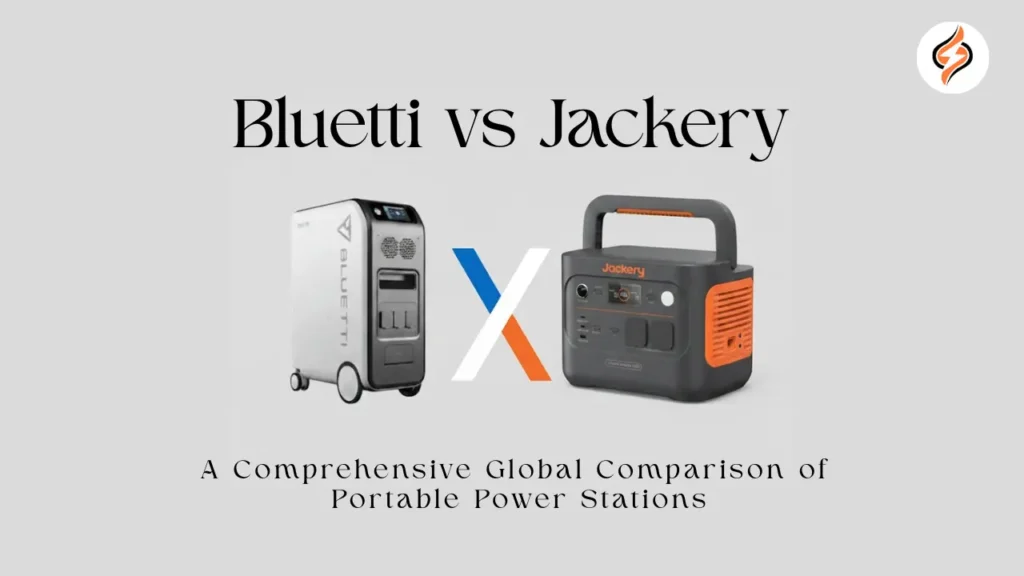
Portable power stations are no longer niche gadgets for campers. They have become essential tools for homes, travelers, and emergency preparedness. As grid reliability weakens and off-grid lifestyles grow, demand for clean, portable energy keeps rising.
People want electricity without noise, fumes, or fuel runs. This is where Bluetti vs Jackery dominate the conversation.
Both brands offer rechargeable “solar generators” capable of powering phones, refrigerators, power tools, and medical devices.
Both have global reach and strong reputations.
Yet they approach portable power from very different philosophies.
This guide delivers a complete Bluetti vs Jackery comparison across product lines, regions, and real-world use cases.
It evaluates capacity, inverter output, battery chemistry, charging speed, solar performance, expandability, safety, pricing, warranty, and user sentiment.
By the end, you will know exactly which brand fits your needs.
Understanding Portable Power Stations
A portable power station is essentially a large rechargeable battery paired with an inverter and multiple output ports.
It stores electricity and delivers AC and DC power on demand.
Unlike gas generators, these units are silent, emission-free, and safe for indoor use.
Most also support solar charging, which makes them attractive for renewable energy setups.
They are commonly used for camping, RV travel, home backup, workshops, and off-grid living.
Their flexibility is why the market has exploded in recent years.
Bluetti and Jackery sit at the top of this growing category.
Section I: Brand Overview
In the following section, we will overview the two brands and discuss their value propositions.
Bluetti: Built for Power, Longevity, and Expansion
Bluetti entered the mainstream portable power market around 2019–2020.
Early crowdfunding successes, such as the AC200 series, helped establish its reputation quickly.
Bluetti made a decisive early move by adopting LiFePO₄ (Lithium Iron Phosphate) batteries.
This chemistry offers exceptional cycle life, thermal stability, and long-term reliability.
While many competitors focused on portability, Bluetti focused on capability.
Its products emphasize high capacity, strong inverter output, and modular expansion.
Bluetti systems are often used for home backup, RV installations, and off-grid solar living.
They feature rugged construction, extensive port selections, and advanced power management.
The brand sells globally with region-specific voltage and socket options.
Bluetti’s core promise is simple: reliable power that scales with your needs.
Jackery: Portability and Simplicity First
Jackery was founded in 2012 and helped popularize portable power for outdoor use.
It introduced many consumers to the idea of solar-powered electricity on the go.
Jackery’s Explorer series became widely recognized for its compact design and user-friendly interface.
The bright orange-and-grey aesthetic is now iconic in the category.
Historically, Jackery used NMC lithium-ion batteries, which are lighter but have shorter cycle life.
This made their products easy to carry and ideal for short-term use.
In recent years, Jackery has evolved.
New models now use LiFePO₄ batteries and support expansion.
Jackery emphasizes simplicity, fast charging, and portability.
Its products are designed to work immediately without technical knowledge.
Section II: Bluetti vs Jackery: Product Lineup Comparison
Bluetti Product Range
Bluetti offers one of the broadest lineups in the industry.
Smaller units like the EB3A (268Wh) and AC60 (~403Wh) serve lightweight charging needs.
These models are suitable for phones, laptops, and small appliances.
Mid-range units such as the EB55 (537Wh) and EB70S (716Wh) provide more output and ports.
They are popular for camping and light off-grid use.
The AC series represents Bluetti’s core offerings.
Models like the AC180 (1,152Wh) and AC200P (2,048Wh) deliver serious inverter power and long battery life.
Bluetti’s premium systems emphasize expandability.
The AC200MAX supports additional battery modules, reaching over 8kWh total capacity.
The AC300 uses a modular inverter and external batteries, scaling beyond 12kWh.
At the high end, Bluetti’s EP500 and EP500Pro are wheeled home-backup units with 5.1kWh capacity.
They target whole-home emergency scenarios.
Bluetti has also pioneered experimental technologies, including sodium-ion battery systems.
This reflects a strong innovation culture.
Jackery Product Range
Jackery’s Explorer series covers a wide spectrum of users.
Entry-level models like the Explorer 160 and Explorer 240 focus on basic charging needs.
They are extremely portable and simple.
Mid-tier options include the Explorer 300 and Explorer 500, which add inverter power for laptops and small appliances.
The 1000Wh category is Jackery’s most popular segment.
The Explorer 1000 V2 introduces LiFePO₄ batteries and faster charging.
Larger models include the Explorer 1500 and Explorer 2000, designed for heavier loads.
Earlier versions were fixed-capacity systems.
Jackery’s major shift comes with the Plus series.
The Explorer 1000 Plus and 2000 Plus support expansion batteries, scaling beyond 10kWh.
Jackery has also entered the home-backup space with the Explorer 5000 Plus, capable of split-phase output.
This marks a strategic expansion beyond portable use.
You May Also Read: Jackery Explorer 5000 Plus Review– The Ultimate Power Solution or Just Hype?
Section III: Battery Technology and Lifecycle
Battery chemistry is one of the most important differences between Bluetti and Jackery.
Bluetti uses LiFePO₄ batteries across nearly all current models.
These batteries typically offer 3,000–3,500 cycles to 80% capacity.
Jackery’s older models used NMC cells with 500–800 cycles.
This limited their suitability for heavy daily use.
However, Jackery has now transitioned most new models to LiFePO₄.
The latest units claim up to 4,000 cycles to 70% capacity.
In real-world terms, both brands now offer batteries that can last 10 years or more.
Bluetti’s advantage lies in earlier adoption and a longer track record.
Section IV: Capacity and Inverter Output
Bluetti generally offers higher base capacity models.
Standalone units range from under 300Wh to over 5,000Wh.
Jackery historically capped around 2,000Wh but now matches Bluetti through expansion packs.
Inverter power also differs slightly.
Bluetti mid-range models often provide higher continuous output.
This allows them to run demanding appliances more easily.
Jackery’s newest flagship systems match or exceed Bluetti at the very top end.
However, those systems are larger and more expensive.
For typical household and outdoor use, both brands provide sufficient power.
The difference matters most for heavy-duty or professional loads.
Section V: Weight and Portability
Portability is where Jackery consistently shines.
Jackery units are significantly lighter than comparable Bluetti models.
This is especially noticeable in the 1,000Wh class.
Bluetti’s heavier build comes from LFP batteries and rugged construction.
This improves durability but reduces ease of transport.
If you carry your power station often, weight matters.
If it stays in one place, weight matters far less.
This trade-off defines many buying decisions.
Section VI: Charging Speed and Solar Performance
AC Charging
Jackery currently leads in AC charging speed.
The Explorer 1000 V2 can charge fully in under two hours.
Some modes push even faster.
Bluetti offers fast AC charging as well, but generally at slightly slower rates.
Some models support dual AC input for faster results.
If fast grid recharge is critical, Jackery has the edge.
Solar Charging
Bluetti excels in solar charging.
Bluetti units support higher solar input wattage.
They also use standard MC4 connectors, allowing third-party panels.
Jackery historically relied on proprietary connectors.
Newer models improve compatibility but remain less flexible.
Bluetti’s MPPT controllers also tend to extract more energy in variable conditions.
This matters for off-grid solar use.
If solar is a core part of your setup, Bluetti is stronger.
Section VII: Ports, Outputs, and Expandability
Bluetti units usually include more ports.
This includes multiple AC outlets, high-watt USB-C, DC ports, and sometimes wireless charging.
Some Bluetti models include dedicated RV outlets and UPS functionality.
These features appeal to advanced users.
Jackery offers fewer ports but covers essential needs.
The layout is clean and intuitive.
Expandability is another major difference.
Bluetti has supported battery expansion for years.
Jackery only recently introduced expansion with the Plus series.
If you expect your power needs to grow, expandability matters.
Section VIII: Safety and Battery Management
Both brands prioritize safety.
LiFePO₄ batteries are inherently more stable than older lithium chemistries.
They resist overheating and thermal runaway.
Both Bluetti and Jackery use advanced battery management systems.
These protect against overcharging, overheating, and short circuits.
Neither brand has a history of major safety recalls.
Both meet international safety certifications.
From a safety perspective, both are reliable choices.
Section IX: Pricing and Regional Availability
Pricing varies by region and promotions.
Jackery often appears cheaper during sales, especially in mid-range models.
Bluetti sometimes offers better long-term value through higher capacity and features.
Both brands sell globally with local warehouses.
Voltage and plug compatibility are region-specific.
Buying from an official regional store is strongly recommended.
Section X: Warranty and Customer Support
Jackery typically offers up to 5 years warranty on newer models.
This includes extended coverage through registration.
Bluetti offers 2–5 years, depending on the model and promotion.
Premium systems often receive longer coverage.
User feedback suggests Jackery has slightly faster customer service response times.
Bluetti’s support has improved significantly in recent years.
Both brands honor warranties reliably.
Section XI: Real-World Reviews and User Sentiment
Independent reviewers consistently rate both brands highly.
Jackery is praised for simplicity, portability, and reliability.
Bluetti is praised for power, features, and expandability.
There is no universal winner.
Most reviews emphasize choosing based on use case.
User communities reflect the same conclusion.
Section XII: Bluetti vs Jackery: Which Brand Is Better for Each Use Case?
Camping and Short Trips
Best choice: Jackery
Lightweight design and fast charging make it ideal for travel.
RV and Van Life
Best choice: Bluetti
Higher solar input, RV ports, and expandability matter here.
Emergency Home Backup
Short outages favor Jackery.
Long outages favor Bluetti.
Off-Grid Living
Best choice: Bluetti
Solar integration and scaling capability are critical.
First-Time Buyers
Best choice: Jackery
Simple setup and intuitive design reduce friction.
Final Verdict: Bluetti vs Jackery
There is no single winner in the Bluetti vs Jackery debate.
Jackery wins on portability, simplicity, and fast charging.
Bluetti wins on capacity, solar performance, and expandability.
The right choice depends on how you live, travel, and prepare.
Both brands deliver clean, reliable power.
Both are pushing the industry forward.
Choose the one that fits your reality, not just the specs.
That is how you win with portable power.
You May Also Read: Ecoflow vs Jackery: Unveiling the Best Portable Power Solution