
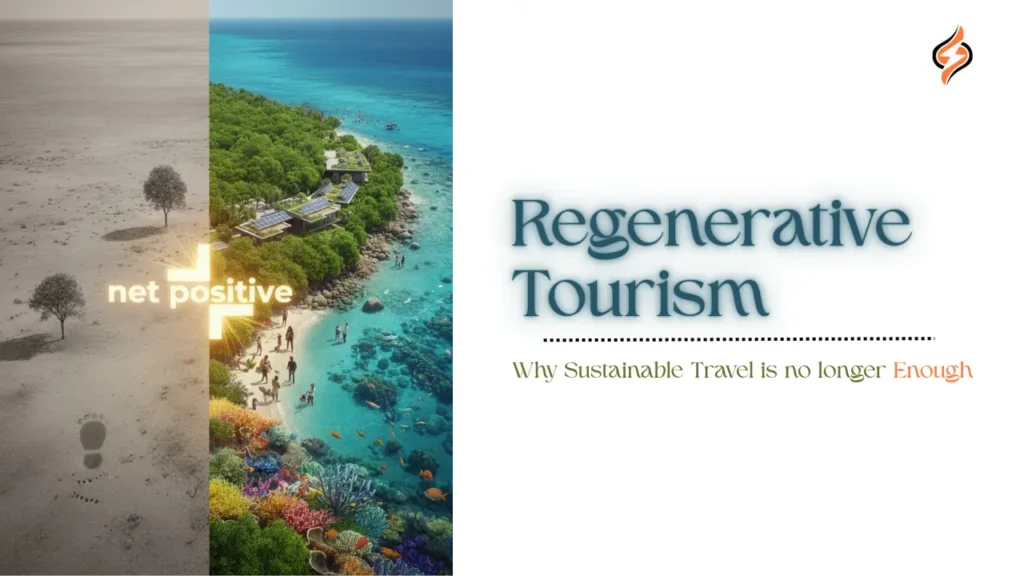
For decades, sustainable tourism has been guided by a simple ambition: reduce harm.
Use fewer resources. Leave no trace. Offset what you consume.
That approach mattered—and it still does.
But in a world facing accelerating climate loss, biodiversity collapse, and overtourism, reducing damage is no longer sufficient.
Tourism today is too large, too influential, and too deeply embedded in local economies to remain neutral. When millions of people move across ecosystems and cultures every day, “doing less harm” merely preserves systems that are already under strain.
A new question is emerging:
What if travel didn’t just sustain destinations—but actively restored them?
This question sits at the heart of generative (or regenerative) tourism—a model that reframes travel as a force for renewal rather than extraction.
In this vision, every journey has the potential to strengthen ecosystems, empower communities, and create value that lasts long after visitors leave.
From Sustainable to Generative: A New Travel Ethos
Traditional sustainable travel focuses on minimizing negative impact:
use less plastic, save water, respect wildlife.
These practices are essential. But in most cases, they simply maintain the status quo.
Generative tourism goes further. It asks a more ambitious question:
How can travel actively improve the places we visit?
How can a trip help revive an ecosystem, strengthen cultural identity, or reinforce local economic resilience?
Think of it this way: sustainable travel is about treading lightly, while generative travel is about leaving a positive footprint.
In practice, this could mean a resort that restores coral reefs while hosting guests, or a tour operator that channels visitor revenue into long-term reforestation. Success is no longer measured only by guest satisfaction, but by measurable benefits for nature and community.
For tourism operators, this means embedding conservation and community development directly into business models.
For travelers, it means choosing experiences that contribute value to the host destination.
Some hotels now operate organic farms that supply both their kitchens and nearby markets, becoming hubs of local food security. Safari lodges fund anti-poaching units. Trekking tours include trail maintenance or habitat restoration as part of the journey.
Crucially, generative tourism is not rooted in guilt or sacrifice.
It is rooted in value creation.
Imagine returning home knowing your presence helped restore a mangrove forest or fund a community school.
Travel gains a deeper sense of purpose. Leisure becomes stewardship. Visitors are no longer passive consumers of experiences, but active participants in shaping healthier places.
You May Also Read: Sustainable Marina Design: Building Eco-Friendly and Resilient Harbors
What Is Generative Tourism?
Generative (or regenerative) tourism can be defined as travel that leaves a destination better than it was before. Inspired by regenerative agriculture—which restores soil health and biodiversity—it applies the same principles to tourism systems.
Rather than merely conserving what exists, generative tourism actively rehabilitates ecosystems, reinvigorates cultures, and rebuilds local economies.
Experts often describe it in terms of net-positive impact. Tourism researcher Dianne Dredge defines it as ensuring that the visitor economy “delivers a net positive benefit for communities, the environment, and the destination.”
In simple terms, a trip should contribute more to a place than the resources it consumes.
This might involve environmental initiatives, such as restoring more forest than the carbon emissions generated by travel. It might involve social initiatives, such as prioritizing indigenous-owned businesses so economic benefits remain local.
A core principle of generative tourism is holism. It considers the entire ecosystem of travel: residents, environment, culture, and the visitor experience. The aim is to create conditions where all elements can thrive together.
This requires long-term thinking. How will a tourism project affect water availability decades from now? Will it strengthen local culture—or gradually erode it?
Generative tourism asks these questions early and plans accordingly, often in collaboration with local communities and informed by indigenous knowledge about living in balance with nature.
Importantly, regeneration is not a one-time achievement. Installing solar panels or banning single-use plastics may help reach sustainability benchmarks, but regeneration is an ongoing process—healing, adapting, and giving back year after year.
It represents a mindset shift: from tourism as an extractive industry to tourism as a reciprocal relationship between visitor and host.
You May Also Read: Portable Power Two Ways: Jackery vs Goalzero
The Hard Truth: Why Generative Tourism is Not Easy
Generative tourism is compelling—but it is not simple.
Delivering net-positive outcomes requires long-term investment, strong governance, and genuine collaboration with local communities. It challenges short-term profit models and demands patience in a sector often driven by rapid growth and quarterly returns.
Measuring “net positive” impact is also complex. Environmental restoration takes time. Social outcomes are not always easy to quantify. Without transparency and accountability, regenerative claims risk becoming another form of greenwashing.
These challenges are real.
But they do not weaken the case for generative tourism—they strengthen it.
If tourism is to remain viable in a world of finite resources and rising expectations, complexity is unavoidable. The choice is not between easy sustainability and difficult regeneration. The choice is between intentional transformation and managed decline.
You May Also Read: Top 10 Sustainable Hotel Innovations: Eco-Friendly Travel Trends
Pioneering Examples of Regenerative Travel
Generative tourism is no longer theoretical. Around the world, forward-thinking destinations and communities are already proving that tourism can restore and uplift, not merely sustain.
Here are some inspiring examples that show regenerative tourism in action:
#1 The Red Sea and Saudi Arabia’s Vision 2030
On Saudi Arabia’s west coast, tourism is being planned around nature, not imposed upon it.
The Red Sea destination spans an archipelago of 92 islands, yet only a limited number will host resorts. More than 75% of the area is designated as protected natural reserve. This restraint is deliberate.
Environmental protection is embedded into master planning, not added later as mitigation. Architecture responds to landforms, climate, and ecosystems. Natural landscapes are restored rather than replaced.
Operationally, the destination is designed to run on 100% renewable energy, with no diesel generators supporting luxury operations. Red Sea Global has committed to large-scale mangrove planting, coral reef restoration, and habitat expansion for endangered species.
The objective is clear: by full operation, surrounding ecosystems should be healthier than before development began.
This reflects Saudi Arabia’s Vision 2030, which reframes tourism as a long-term investment in ecosystems, communities, and future generations—prioritizing value and longevity over volume.
#2 Playa Viva, Mexico:
On Mexico’s Pacific coast, Playa Viva demonstrates regenerative tourism at a boutique scale.
Built on degraded farmland, the resort was designed from the outset to restore land while supporting local livelihoods. It operates off-grid on 100% solar power, uses locally sourced materials, and employs staff from nearby villages with fair wages and long-term training.
An on-site permaculture farm supplies the kitchen and strengthens local food security while sharing regenerative farming knowledge with the surrounding community.
You May Also Read: Going Green on the Go: 11 Smart Strategies for Decreasing Your Travel Carbon Footprint
#3 Rewa Eco-Lodge, Guyana:
In Guyana’s rainforest, the indigenous Makushi community operates Rewa Eco-Lodge, fully owned and managed by the village.
Tourism revenue is shared among approximately 300 residents and has enabled a shift away from resource extraction toward conservation. The community now protects a 350-square-kilometer rainforest area, funding patrols that prevent illegal logging and poaching.
Tourism income supports education, healthcare, and conservation management—demonstrating how local ownership makes regeneration both credible and durable.
#4 Fogo Island Inn, Canada:
In Newfoundland, Fogo Island Inn was created as a response to the collapse of the cod fishing industry.
Structured as a social enterprise, the inn reinvests profits into community development. Local residents are employed, and local craftsmanship defines the guest experience—from furniture to food traditions.
Traditional skills have been revitalized, younger generations have reasons to stay or return, and cultural knowledge is treated as a living asset.
Fogo Island shows that regeneration extends beyond ecology. Cultural continuity and economic resilience are equally vital.
These examples – from large-scale developments backed by billions, to small community projects in the jungle – all share a common ethos.
They use tourism as a tool to renew, not degrade. They prove that travel can be a catalyst for planting forests, saving species, celebrating cultures, and creating local wealth.
Generative tourism is not theoretical; it’s happening right now in pockets of the world, lighting a path for others to follow.
You May Also Read: 5 Compelling Reasons to Choose Sustainable Travel Companies
How Travelers Become Regenerative Actors
Generative tourism does not require building a resort. It begins with direction, not perfection.
If you’re wondering how you personally can “live greener” and travel better, here are some practical, simple steps:
#1 Choose Travel Providers that Give Back:
Whenever possible, pick hotels, tours, or cruise lines that demonstrate a commitment to sustainability or regeneration.
Look for information on their websites about environmental projects or community programs they support.
Does your hotel have solar panels or a recycling program?
Does your tour operator hire local guides and respect wildlife?
By choosing providers with green certifications or a proven track record, you vote with your wallet for better tourism. For example, staying at an ecolodge that plants trees or a tour that donates to conservation means your trip inherently leaves a positive trace.
#2 Travel Slow and Light:
Slow travel is greener travel. Take fewer flights – especially avoid short hops – and opt for trains or efficient public transport when you can.
Consider exploring one region deeply rather than cramming five cities into a week.
Slow, longer stays not only cut down carbon emissions (fewer transport miles) but also let you form a connection with the place, spend more at local businesses, and reduce the stress on popular sites.
When you do fly, fly economy and pack light – lighter planes use less fuel. Every kilogram counts.
And of course, offset your carbon emissions if you can (many airlines and independent programs let you fund tree planting or renewable energy to balance out your flight’s footprint).
A slower, lighter journey is not a sacrifice – it often means a richer experience and a more relaxed you, all while being kinder to the planet.
#3 Respect and Restore Nature:
When you’re out enjoying natural areas, practice the classic principles of “leave no trace”.
Stick to marked trails,
carry out all your trash (maybe even pick up any litter you see),
and avoid disturbing wildlife.
But to be regenerative, consider going a step further: Is there a way to leave a place better?
Many destinations now offer traveler-volunteering opportunities, like beach clean-ups, tree planting days, or citizen science projects.
Spending just a couple of hours of your trip giving back to the local environment – say, joining a coral reef cleanup dive or helping scientists count turtles – can make a tangible difference.
It also connects you more deeply to the place. Even simpler: you can “restore” by supporting organizations that do the work year-round.
A small donation to a local conservation charity or national park, as a thank-you for the beauty you enjoyed, is a wonderful habit to cultivate.
#4 Engage with and Support Local Communities:
One of the joys of travel is meeting new people and learning how they live. Embrace that fully.
Eat at family-run restaurants,
shop at local markets and artisans,
hire local guides,
stay in locally owned accommodations when possible.
This pumps money directly into the community. Be curious and respectful – learn a few words of the local language, understand local customs, and always ask before photographing people or sacred sites.
The more you show respect, the more trust builds between visitors and residents.
In some places, you can even spend time with community projects (visit a cooperative, a school, a community farm).
These interactions are often the most memorable parts of a trip. By being a traveler who values people over landmarks, you ensure your trip benefits those who host you.
Strong communities are the backbone of regenerative tourism, so supporting local culture and livelihoods is key to being a green traveler.
#5 Minimize Waste and Footprint:
Little habits on the road add up. Carry a reusable water bottle (and filter if needed) to avoid disposable plastic bottles – this can save dozens of plastics on a single trip.
Bring a reusable shopping bag and say no to plastic bags for souvenirs or groceries. Pack a set of travel utensils or a straw if you know you’ll get takeout food.
These simple actions prevent waste in destinations that might not have robust recycling.
Also, conserve resources at your hotel like you would at home: turn off lights and AC when you leave the room, reuse your towels, take shorter showers to save water (especially in places suffering droughts).
By treating resources as precious everywhere you go, you lighten your impact. Many of these are common sustainable travel tips, but in the spirit of regeneration, think of it this way: the less you consume unnecessarily, the more resources stay available for the local community and environment. It’s about being a thoughtful guest. Every kilowatt or liter saved is one that can serve others or stay in nature.
By adopting even a few of these habits, you transform from a passive tourist into an active steward of the places you visit.
Generative tourism isn’t a distant ideal; it starts with each of us making mindful choices on the road.
And far from making travel boring, these choices often lead to more authentic and enriching adventures.
You’ll meet passionate locals, discover off-the-beaten-path wonders, and return home not just with photos, but with the satisfaction of having been part of something meaningful.
You May Also Read: 27 Best Eco Friendly Travel Products
Conclusion
Tourism has always shaped the world. It has built economies, transformed landscapes, and influenced cultures—sometimes for the better, often at a cost.
The question is no longer whether tourism has impact.
The question is what kind of impact we choose to design.
Generative tourism marks a decisive shift—from minimizing harm to maximizing contribution. It reframes travel as a reciprocal relationship, where destinations are not consumed, but strengthened.
For industry leaders, this is both responsibility and opportunity. Net positive impact is fast becoming the new benchmark of excellence.
For travelers, the message is empowering. Every journey can help support what is good and repair what is broken—through intention, curiosity, and care.
When travel restores ecosystems, sustains cultures, and strengthens communities, it becomes more than movement.
It becomes participation in a healthier, more resilient world.