
Every time you chat with an AI, something happens behind the scenes — servers start humming, fans spin to keep them cool, and electricity begins to flow. Ever wondered, what is the environmental cost of Generative AI?
It feels almost magical when ChatGPT writes a paragraph in seconds, doesn’t it? But that instant response takes a lot of computing power. What we call “the cloud” isn’t floating somewhere in the sky — it’s made up of thousands of real machines sitting in giant, air-conditioned data centers.
Each question you ask triggers countless calculations. Those calculations consume energy — and that energy has a carbon footprint. The convenience feels effortless, but the process is far from clean.
Let’s take a closer look the environmental cost of generative AI, and what we can do to make it a little greener.
Why Generative AI Consumes So Much Power
Generative AI models are enormous. They don’t think like humans; they calculate.
Modern systems like GPT-4 contain hundreds of billions of parameters — tiny digital knobs that determine how the AI responds.
Just a few years ago, models had millions of parameters. Now, they’re hundreds of times larger. More parameters mean more math, and more math means more electricity. For perspective, just a few years ago an advanced AI model might have had around 100 million parameters. By 2019, GPT-2 jumped to 1.5 billion, and GPT-3 in 2020 leapt to 175 billion parameters. While GPT-4 uses an enormous number of 1.8 trillion parameters.
Running a large AI model isn’t like running a simple app on your laptop – it often means coordinating thousands of these power-hungry chips in data centers. One expert noted that a generative AI training cluster can use seven or eight times more energy than a typical data center workload. In other words, teaching an AI model to write or draw is far more electricity-intensive than traditional server tasks like hosting websites or running business software.
Moreover, generative AI requires handling and storing enormous amounts of data. The training phase involves processing hundreds of billions of words or images, which takes weeks of continuous computing. Even after training, using the model (also called inference) remains heavy.
To produce a single sentence of response, the AI might perform billions of math operations across many layers of the neural network. All of this happens on servers in a data center somewhere – a physical building full of computers that need constant power and cooling. The cooling is essential because those hardworking chips get hot; large industrial chillers or fans run non-stop to keep temperatures in check, which adds to energy usage.
In short, AI is energy-intensive because it’s massive, complex, and constantly working. Every query you make sets off a global chain reaction of computation, cooling, and power consumption.
The Numbers Behind a Single Prompt
Talking about energy in abstract terms only gets us so far. Let’s put some concrete numbers on that “invisible meter” we mentioned.
How much energy does a single AI prompt actually use, and what does that mean in familiar terms?
a. Individual Query Energy:
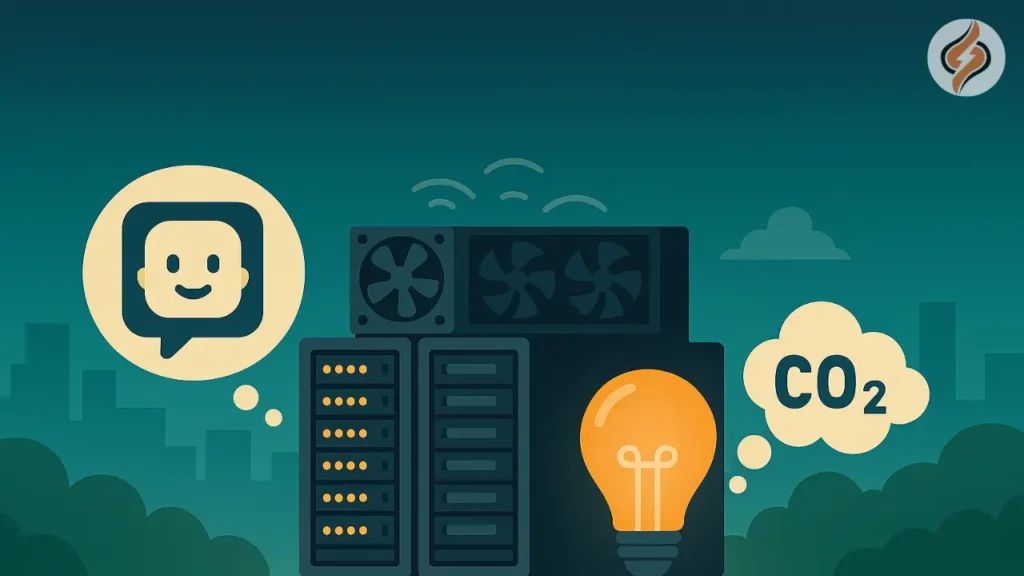
By some industry estimates, asking ChatGPT one question uses roughly 2 to 3 watt-hours (Wh) of electricity. Watt-hour is a measure of energy – for perspective, about what it takes to power a 100-watt light bulb for 1–2 minutes.
Another way to look at it: the energy for one AI query is around 10 times that of a typical Google search. (Search engines are extremely optimized, so a single search uses only a few tenths of a Wh; even 10× that amount is still a small absolute number, but it’s a jump for essentially the same user action – typing a query).
In practical terms, if you asked an AI a question while flicking on a small LED lamp, the lamp might glow for a few minutes on the energy the AI just burned to answer you.
b. Carbon Footprint per Prompt:
Energy use translates to carbon emissions if the electricity isn’t 100% renewable. Based on averages, one AI prompt might be responsible for about 2–3 grams of CO₂ released into the atmosphere.
That’s including a share of the emissions from the model’s training phase as well (since training is a one-time cost, researchers can amortize it per query).
A few grams of CO₂ per question sounds tiny – and indeed, for a single user it is. Even if you prompted an AI 50 times, you’d emit on the order of 100 grams of CO₂, which is like driving a car a few hundred meters.
By comparison, a gallon of gasoline burned by a car produces over 8,887 grams of CO₂.
So, one prompt isn’t even a drop in that bucket. However, scale this up to millions of users and repeated use, and it starts to look more significant (more on the global scale in a moment).
c. Training Phase Energy Bomb:
The real eye-opener comes from looking at the creation of these AI models. Training a large model is an energy-intensive marathon.
For example, OpenAI’s GPT-3 (one of the early generative text models with 175 billion parameters) has been estimated to consume around 1,300 megawatt-hours (MWh) of electricity during training.
That is 1.3 million kWh – roughly the amount of electricity an average U.S. home would use in over 120 years!
In terms of carbon, the training process for GPT-3 likely emitted on the order of 500 metric tons of CO₂ or more.
Think of 500 tons of carbon dioxide – that’s comparable to the annual emissions of about 100 gas-powered cars, or to flying a full Boeing 747 passenger jet back and forth across the Atlantic a couple of times. And that’s for training a single model.
Newer models are even larger: GPT-4’s training was reportedly 50× more energy than GPT-3’s, indicating an exponential growth in resource needs.
It’s as if each new generation of AI model is upping the ante dramatically on the energy required to bring it to life.
A Prompt’s Share of That: Now, you might wonder how that training cost factors into “per prompt” cost.
If we spread GPT-3’s training emissions across all the queries it will ever answer, each answer would “inherit” a bit of that carbon debt.
Researchers who attempt these calculations come up with the few grams of CO₂ per prompt figure mentioned earlier.
So, every time you enjoy a quick AI-generated answer, remember that a massive upfront investment of energy was made to train the model, and a tiny slice of that investment is effectively spent each time it responds.
d. Hypothetical Scenarios:
Let’s consider a what-if. Google processes about 8–10 billion searches per day worldwide. If all of those were handled by a ChatGPT-style AI instead of traditional search algorithms, the energy requirement would be astronomical – estimates peg it at nearly 10 terawatt-hours (TWh) of electricity per year.
That’s about as much power as 1.5 million people in a developed country use in a year, just for AI answering search queries.
We are not at that point (AI hasn’t fully replaced search engines, and AI queries are fewer), but it illustrates how quickly the numbers climb with wide adoption.
In summary, one prompt’s direct energy cost (a few Wh and a few grams CO₂) is small for an individual, but not negligible when multiplied by many users and many prompts.
And behind each prompt lies a much larger behind-the-scenes energy expenditure from training. The numbers show that while each question you ask an AI won’t melt a glacier on its own, the collective effect of billions of prompts – plus the training overhead – is a serious matter.
It’s the classic case of tiny actions adding up when scaled globally.
Hidden Layers of Environmental Impact of Generative AI
When we talk about the environmental impact of generative AI, it’s important to realize it’s not a one-time event but a continuous story.
There are multiple phases in an AI model’s lifecycle, each with its own resource footprint.
Let’s peel back the layers:
Layer #1 Training:
This is the big one we just discussed. Training is when the AI is first “taught” on vast datasets (like scraping text from the internet or images, etc.).
It’s a one-off process per model version, but it’s extremely energy-intensive.
Picture a data center full of servers running non-stop for weeks or months to train a single model – that’s what it takes.
As noted earlier, training a state-of-the-art model can emit hundreds of tons of CO₂. It’s also where a lot of water gets used, because data centers need cooling.
Some research found that training GPT-3 in a specific data center could have consumed about 700,000 liters of clean water through cooling requirements.
That’s enough water to fill a large swimming pool, vaporized as heat management for one AI model’s birth. These are the hidden environmental costs at the very start of an AI’s life.
Layer #2 Fine-Tuning:
Many generative AI models don’t stop at the initial training.
Companies often fine-tune them on narrower data (for example, OpenAI fine-tuned GPT-3.5 on conversation data to make ChatGPT, and then fine-tuned again for different tasks or to align with human feedback).
Fine-tuning is less computationally heavy than full training but still significant – it might involve running those same power-hungry GPUs for several more days or weeks.
Moreover, the AI field is evolving so fast that models have a short shelf life. Newer versions or competitor models come out every few months.
This means the cycle of training and retraining keeps repeating. The energy used to train a model might effectively go “to waste” if that model is replaced or upgraded soon after.
It’s like building a huge factory that you plan to demolish and rebuild better within the year – not exactly efficient from a resources point of view.
These frequent training cycles and tuning sessions add hidden layers of ongoing energy cost beyond that first big training run.
Layer #3 Daily Usage:
Once an AI model is deployed, the work is not over – in fact, it’s just beginning.
Every time someone uses the model, that’s an inference step: the model is loaded on hardware and processing your input to generate output.
For popular services like ChatGPT, image generators, or AI assistants, inference happens millions of times per day across the user base.
Individually, each inference uses less energy than training, but collectively this usage phase can rival or even exceed training in total energy consumed.
Think of it this way: training is a huge one-time power surge, whereas inference is like a constant power draw that keeps accumulating as people keep using the model.
Some data from Google engineers suggested that for their AI services, inference accounted for about 60% of the total energy footprint while training was 40%.
And the balance could tilt further as user demand grows. It might take only a few weeks of heavy usage for a wildly popular model to burn more energy answering questions than was used to train it in the first place.
There are other “hidden” environmental layers too, beyond these core phases. For instance, manufacturing the hardware for AI – the GPUs and server racks – has its own carbon footprint.
These advanced chips require mining rare earth minerals and complex fabrication processes, which generate emissions and sometimes toxic waste.
Additionally, when hardware gets upgraded frequently to faster, more efficient versions, the old equipment can become electronic waste (e-waste).
Some projections suggest that by 2030, the e-waste from AI hardware upgrades could reach millions of tons globally. It’s yet another indirect cost of our AI revolution.
In other words, AI’s footprint spans its entire lifecycle: production, training, operation, and disposal. What we see on screen is just the tip of the iceberg.
The Global Scale — When Curiosity Meets Carbon
Individually, an AI prompt’s footprint seems small, but our collective curiosity is leaving a growing mark on the planet. The rise of generative AI is starting to reflect in global energy and emissions numbers, and it’s worth understanding the scale.
Data centers already use around 460 terawatt-hours of electricity each year. If they were a country, they’d rank as the 11th largest electricity consumer in the world — ahead of many developed nations.
With AI expanding fast, that number could double by 2026, approaching 1,000 TWh annually. The digital world could soon consume as much energy as Japan.
The tech sector now accounts for about 2–3% of global greenhouse gas emissions, rivaling aviation. And AI’s share is rising. Some estimates suggest emissions from data centers could triple by 2030 due to AI demand.
Even tech giants are feeling the strain.
Microsoft’s operational emissions rose 30% between 2020 and 2023, and Google’s emissions increased nearly 50% in the same period — both attributing the surge to AI workloads.
This rapid growth also puts pressure on power grids and water supplies. Some regions have paused new data-center construction because the local grid couldn’t handle the demand.
Our curiosity is powerful — but when billions of people use AI daily, the combined energy draw becomes enormous.
Making AI Greener — Emerging Solutions
The situation sounds dire, but it’s not hopeless. Innovation and conscious planning can help rein in the environmental cost of generative AI. Researchers, companies, and policymakers are exploring ways to make AI more sustainable, from the design of chips all the way up to how we use these models.
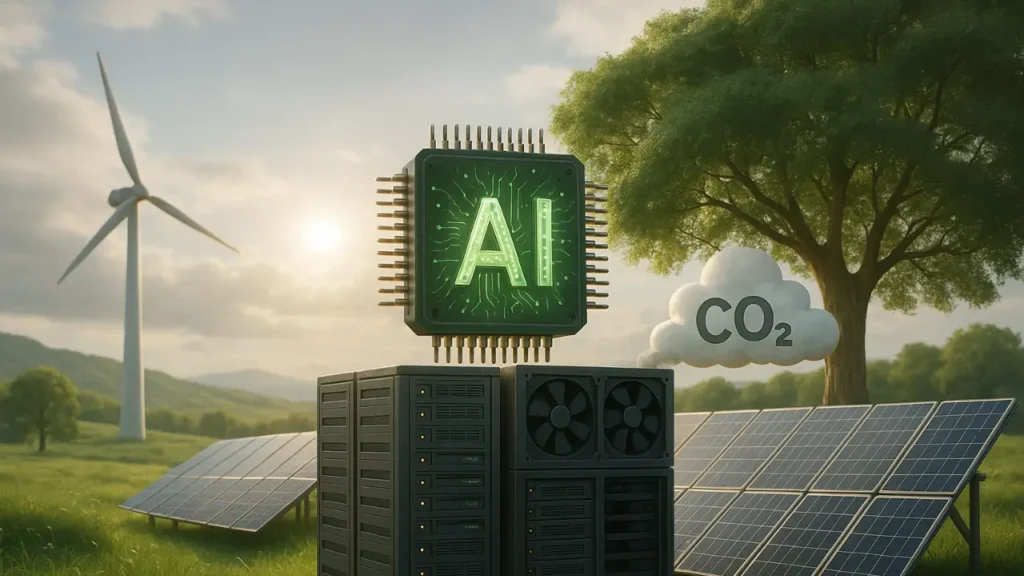
Here are some of the promising ideas and solutions emerging:
1. Efficient Hardware:
One clear path is to build more efficient brains for the AI.
Chip makers are developing specialized AI processors that deliver more computations per watt of power.
For instance, new AI accelerator chips claim significant performance gains while using a fraction of the energy of general-purpose GPUs.
NVIDIA (a leading GPU manufacturer) has touted a new “AI superchip” that could run certain generative AI services with up to 25× less energy.
Similarly, research into 3D chip designs and better cooling methods could reduce the power waste in current hardware.
The goal is that future data center servers can do the same AI work with far less electricity burned.
You May Also Read: Sustainability and Transformation Plans: Beyond Greenwashing
2. Smarter Software:
Not all improvements have to be physical; many are in the code. AI researchers are actively looking for ways to make models more efficient without sacrificing capability.
Techniques like model pruning (cutting away unnecessary parts of the neural network after training), weight quantization (using lower-precision calculations that require less power), and knowledge distillation (training a smaller model to mimic a larger one’s behavior) can dramatically cut down the size and computation needed for AI models.
There’s also an effort to develop algorithms that can achieve the same results with less data or fewer training iterations.
Even small efficiency gains per operation, when multiplied across billions of operations, can make a dent in energy use.
In the future, we might have AI models that are both smart and lean, rather than the current trend of “bigger is better.”
3. Renewable Power:
One of the most straightforward ways to green the AI supply chain is to run data centers on clean electricity.
Many tech companies are already big purchasers of renewable energy for their facilities. Google, Microsoft, and others have goals to power their data centers with carbon-free energy as much as possible (some aim for 100% round-the-clock renewable in the coming decade).
Placing new data centers in regions with abundant wind, solar, or hydro power can help ensure that an AI prompt is being answered with minimal fossil fuel burn behind the scenes.
There are also explorations into on-site clean energy solutions. Imagine data centers with their own solar farms, or even small nuclear reactors, to supply steady power without emissions.
As of now, coal is still a major source of electricity in many grids, but the positive news is that renewable energy is the fastest-growing power source globally.
If we align AI’s growth with the green power surge, we can mitigate a lot of its carbon impact.
4. Dynamic Scheduling:
Data centers don’t have to run at full throttle 24/7 regardless of conditions.
One smart approach is to time certain AI operations to when energy is cleaner or more available.
For example, training jobs (which are flexible in timing) could be scheduled during periods of the day when there’s surplus solar or wind power on the grid.
Some companies are exploring “follow the sun” strategies where workloads shift between data centers in different time zones to take advantage of daytime solar generation.
Additionally, advanced cooling systems are being tested – such as using outside air on cool nights, liquid cooling directly to chips, or even submerging servers in special fluids – to cut down the energy needed for cooling. These efficiency tweaks can add up.
You May Also Read: Melting Mountains, Rising Waters: GLOF Flash Flooding in Gilgit-Baltistan
5. Smaller, Task-Specific Models:
Another solution is more about how we use AI rather than how we build it.
Instead of always reaching for the biggest, most general AI model for every task, we could use smaller, task-specific models when appropriate.
For instance, if you have an AI that just does grammar checking, it doesn’t need to be a 175-billion-parameter behemoth. A much tinier model could do that job with virtually no quality loss and a fraction of the energy.
The industry is starting to recognize the value of a toolbox approach. Using big models for the really hard, open-ended problems, but switching to efficient smaller models for simpler or specialized tasks.
This mindset shift (“right-sizing” the AI for the task) can prevent wasteful over-computation. It ties into the concept of being more selective about how and where AI is applied.
Just because we can throw a huge AI at every problem doesn’t mean we should.
6. Transparency and Reporting:
Policymakers and stakeholders are pushing for more visibility into AI’s energy consumption.
In the EU, for example, there have been discussions about regulations that would require large AI systems to log and report their energy use and carbon footprint.
If companies and the public can track exactly how much juice these AI models are using, it creates an incentive to optimize and an opportunity to compare efficiency.
Imagine an “energy star” rating for AI services or an environment label next to your AI apps. We’re not there yet, but that conversation has started.
And some organizations are voluntarily publishing sustainability reports that include the impact of their AI features.
7. Carbon Offsets and Removal:
As a near-term band-aid, some companies purchase carbon offsets to counteract the emissions from their data centers.
This might include investing in tree planting, renewable energy projects, or emerging tech like direct air capture of CO₂.
While offsets are not a perfect solution (reducing actual emissions is better), they show that companies acknowledge the footprint and are at least taking responsibility financially.
Looking ahead, firms like Microsoft have even invested in carbon removal technologies, aiming to actually remove as much carbon as they emit (or more) over time.
The ultimate vision would be AI that’s not just carbon-neutral, but maybe even carbon-negative if paired with enough green initiatives.
8. AI for Sustainability:
There’s a bit of poetic justice in leveraging AI itself to drive sustainability.
AI can optimize data center operations. For example, Google famously used machine learning to cut the energy used for cooling in its data centers by predicting exactly how to adjust fans and chillers for maximum efficiency.
AI can also aid the broader adoption of renewables by forecasting energy supply and demand, thus helping grid operators use more green power and less fossil backup.
And outside the data center, AI is being applied to problems like improving building energy use, optimizing logistics for fuel savings, and accelerating materials science for better batteries and solar panels.
If these applications succeed, the net effect could be that AI helps reduce more emissions elsewhere than it consumes itself.
Some reports even suggest that by 2030, wise use of AI could help cut a significant chunk (several percent) of global emissions through such efficiency gains in various sectors.
The challenge is big, but innovation is catching up. With the right design, AI can evolve from being a heavy energy user to a force for sustainability.
How You Can Use AI Responsibly
While big-picture solutions are in development, what can you do in the meantime? It turns out there are practical steps and habits that can make your personal use of AI more environmentally friendly. You don’t need to give up these amazing tools – just use them wisely.
You May Also Read: Best Complete RV Solar System with Batteries
Here are some tips for responsible AI use in everyday life:
- Think Before You Prompt:
Ask only what you need. Combine related questions into one prompt to reduce redundant processing. - Write Clear Prompts:
Well-phrased questions save multiple retries. The fewer rounds you need, the less energy is used. - Choose Lighter Modes:
When possible, use “lite” or “eco” versions of AI tools. Small models can handle simple tasks efficiently. - Support Green Platforms:
Favor services powered by renewable energy. Many companies now disclose this in their sustainability reports. - Adjust Settings:
Generate fewer images or drafts if one will do. Avoid unnecessary high-resolution or multiple iterations. - Spread Awareness:
Encourage mindful AI use in your circle. Awareness alone can drive collective change.
Every small change matters. Mindful use doesn’t mean missing out on innovation — it means using technology responsibly.
Final Thoughts — Environmental Cost of Generative AI
Generative AI is one of the most powerful tools of our time. It saves time, sparks creativity, and connects people across the world. But every innovation comes with a price.
When we flip a switch, we know it uses power. AI should be no different.
Every prompt consumes energy, and every user shares responsibility.
We can still enjoy AI’s benefits while staying conscious of its costs. Use it thoughtfully. Support cleaner technologies. Encourage transparency and efficiency.
If millions of users act with awareness, we can turn this digital revolution into a sustainable one. The future doesn’t have to choose between curiosity and conservation — we can have both.
Every prompt has a price. But with knowledge, we can make that price smaller — and the world greener.
You May Also Read: Sustainability Trends in Golf Courses: Innovations Shaping the Sport
References
- MIT News – Explained: Generative AI’s Environmental Impact (Jan 2025)
- Columbia Climate School – AI’s Growing Carbon Footprint (Jun 2023)
- The Sustainable Agency (Akepa) – Environmental Impact of Generative AI: 30+ Stats & Facts (Sep 2024)
- Hannah Ritchie – What’s the Carbon Footprint of Using ChatGPT? (May 2025)
- World Economic Forum – AI and Energy: Will AI Reduce Emissions or Increase Power Demand? (Jul 2024)
- University of Cambridge – Think Before You Prompt: Reduce Your AI Carbon Footprint (May 2025)