
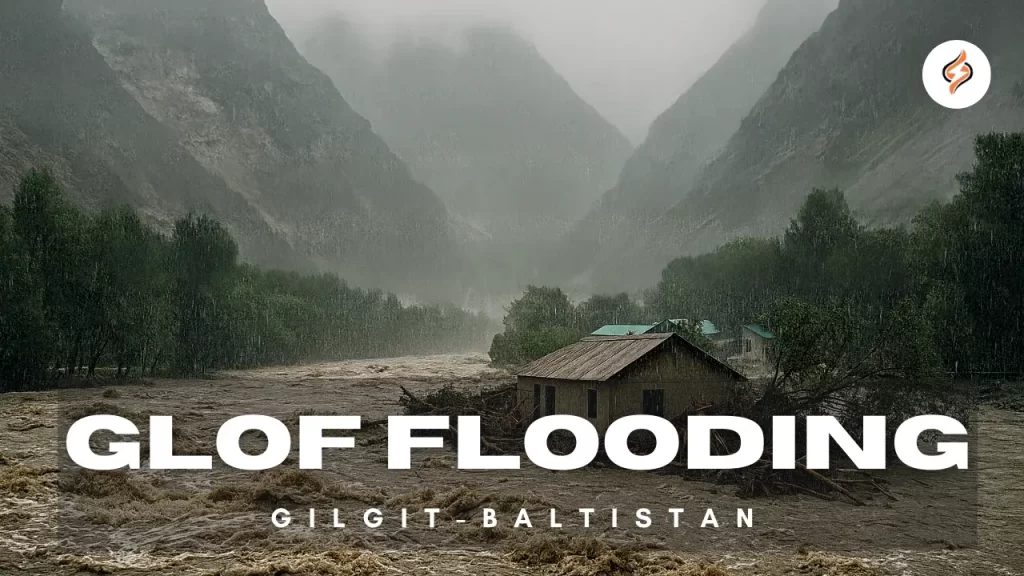
Gilgit-Baltistan’s high mountain valleys – home to over 7,000 glaciers – are facing an unprecedented threat from climate-driven floods. In the recent years, a series of extreme GLOF floods fueled by unusual heat, accelerated glacier melt, and erratic rainfall patterns have devastated communities in northern Pakistan.
This region, famed for its snow-capped peaks and glacier-fed rivers, now finds itself on the front lines of the climate crisis. Villages have been washed away, families displaced, and vital infrastructure destroyed as nature’s forces grow more extreme.
In this post, we explore how climate change is intensifying floods in Gilgit-Baltistan, the impact on local people and livelihoods, the unique challenges of this mountainous region, long-term risks, and the urgent efforts.
Recent Floods and Their Impact on Communities
In the past few years, Gilgit-Baltistan and neighboring northern areas have witnessed devastating floods that upended daily life.
In 2022, record monsoon rains combined with a severe heat wave to produce the worst flash flooding in Pakistan’s history. While much of the country’s south was inundated, the mountainous north was not spared: glacial lakes burst after the extreme heat, sending torrents of water down valleys. At least 23 people were killed in Gilgit-Baltistan alone, with 4 missing, as floods and landslides swept away homes and blocked the vital Karakoram Highway.
Entire villages in valleys like Ghizer and Nagar were cut off when roads and bridges washed out, stranding residents and crippling connectivity.
In one striking example, a glacial lake outburst flood (GLOF) from the Shisper Glacier in May 2022 destroyed the Hassanabad Bridge on the Karakoram Highway – a key trade link to China. It wiped out dozens of homes, a community center, and two small hydropower plants in minutes. The collapse of that bridge underscored how quickly infrastructure can be lost; it caused massive traffic jams and cut off local communities until emergency repairs were made.
History Repeats: Floods of 2025 in Gilgit Baltistan
Fast forward to 2025, and the cycle has tragically repeated. Above-average monsoon downpours and extreme glacier melt have again brought destruction across the north.
By mid-August 2025, over 300 people had been killed by floods across Pakistan, raising fears of a repeat of 2022’s disaster.
Gilgit-Baltistan was hit by intense flash floods and landslides in July and August as glacial lakes suddenly burst after extreme heat. “We are facing a flood situation in many areas,” reported Zakir Hussain, head of Gilgit-Baltistan’s disaster management authority, calling the fast formation of volatile glacial lakes “highly hostile” to people’s safety.
In one August 2025 incident, a massive GLOF swelled the Hunza River, battering crops and damaging highways. It triggered a mudslide in the town of Danyor that tragically killed seven volunteers who were repairing a flood-damaged drainage channel.
Several homes were wrecked and families had to be evacuated to safer areas as first responders rushed in with tents, food, and medicine.
Tourists in the popular valleys were also caught in the chaos – for example, sudden floods stranded over 200 visitors at Fairy Meadows and Hunza until they could be airlifted out to safety.
The human toll of these floods has been severe: lives lost, hundreds of families displaced, farms and orchards destroyed, and critical infrastructure in ruins.
Impacts on Local Communities
The immediate impacts on local communities are profound. Many villages have lost access to roads, power, and clean water when floods washed out power lines and water systems.
Swaths of agricultural land – the source of livelihood for most rural families – have been devastated by silt and debris or completely swept away.
“It is like hell,” said one resident of Gilgit after his fields were flooded. “I have never witnessed such summer conditions in Gilgit… flash floods have destroyed our crops”.
Local economies have suffered as markets and roads close; even tourism, a growing source of income in these scenic areas, has taken a hit due to unsafe travel conditions. The recurring floods have also inflicted psychological trauma and uncertainty.
Many residents now live on edge whenever temperatures spike or rain clouds gather, worried that the next flood could be around the corner.
The displacement of communities is an ongoing reality – in some cases, people have had to abandon ancestral villages entirely. For instance, Attabad, Hunza was destroyed by glacial lake floods in the late 2000s, and much of the population had to relocate, essentially becoming climate refugees in their own homeland.
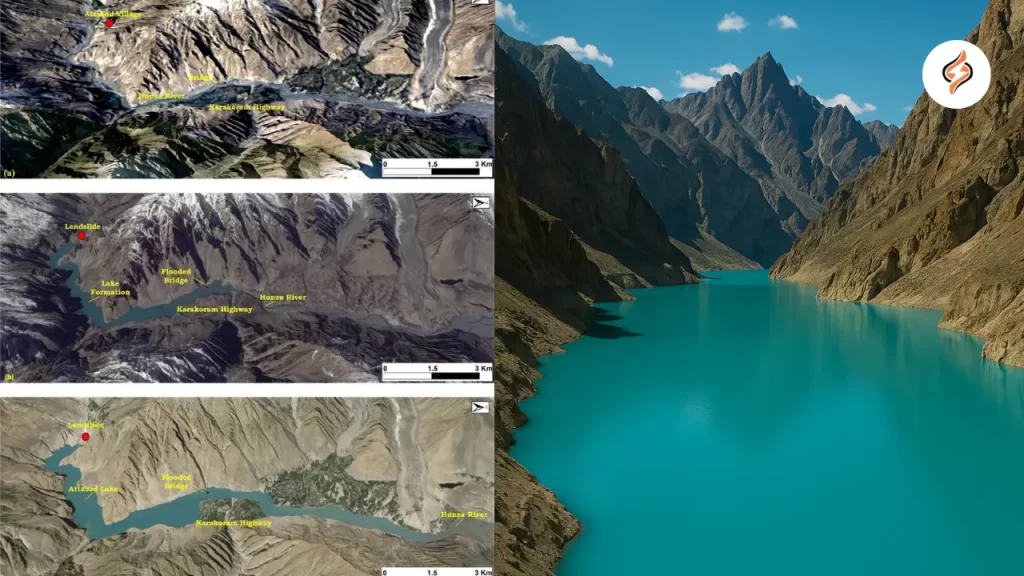
This cycle of disaster and recovery is stretching the resilience of mountain communities to its limit.
Climate Change and the Rise of Glacier-Fed Floods
Why are floods in Gilgit-Baltistan getting so intense and frequent?
Scientific evidence links these disasters directly to climate change.
Pakistan’s northern mountains form part of the Himalayan-Karakoram range, often called the “Third Pole” for its vast store of ice.
Record-Breaking Heat
Temperatures here are rising, and the region recently experienced heatwaves previously unheard of at high altitude.
In summer 2025, parts of Gilgit-Baltistan hit 48.5 °C (119 °F) – a shocking record for an area over 1,200 m above sea level that is renowned for its cool, snow-covered peaks.
The head of Gilgit-Baltistan’s disaster authority described the situation as unprecedented: “The rise of temperature has sent a shiver down our spines. We have never before witnessed such weather here”.
Glaciers Melting at Alarming Rates
These extreme temperatures turbocharge the melting of glaciers. Glaciers that should melt slowly over summer are now pouring out water at alarming rates, forming swollen glacial lakes that can burst without flash flooding warning.
Scientists confirm that rising temperatures – driven by global climate change – are accelerating glacier melt in Pakistan’s northern mountains, increasing both the size and number of glacial lakes. When the natural ice dams or debris holding these lakes back give way, millions of cubic meters of water are released in a flash flood downhill.
Disrupted Rainfall Patterns
Climate change is also disrupting weather patterns, making rainfall more erratic and extreme. The 2022 floods followed record-smashing heat and an unusually intense monsoon. Studies found that the warming climate made the 2022 monsoon rains significantly worse: one analysis estimated the rainfall that summer was about 50% heavier due to global warming.
In 2025, a World Weather Attribution study (an international team of scientists) found that the late June–July rains were 10–15% heavier because of climate change.
Warmer oceans (the Arabian Sea is warming rapidly) are feeding more moisture into the monsoon, and a warmer atmosphere holds more water vapor, leading to torrential downpours when conditions.
Deadly Combination: Heat + Rain
The combination of glacial melt and extreme rainfall is particularly destructive. In late spring, early heat waves can trigger premature snowmelt and glacier melting, filling glacial lakes to the brim by early summer.
Normally, glaciers would melt gradually and feed rivers in a predictable way. Now, the timing is off – glaciers are melting earlier and faster than before. “Glaciers typically begin to melt in late spring or early summer.
When heavy rainstorms hit on top of that, rivers and streams rapidly overflow, causing flash floods. The 2022 and 2025 flash floodings are a clear example: a severe heat wave in May–June (linked to climate change) caused both glaciers to flood in the north and primed a “monsoon on steroids” in the south.
Climate Injustice
It’s important to note that Pakistan contributes less than 1% of global greenhouse gas emissions, yet it ranks among the countries most vulnerable to climate impacts.
The plight of Gilgit-Baltistan embodies this climate injustice: communities with a small carbon footprint are grappling with outsize consequences of global warming.
The mountains of the Third Pole are heating up, and with that comes an amplified water cycle – more glacial melt, unpredictable rains, and greater flood risk. Unless global emissions are curbed and warming slows, scientists warn that today’s floods could be just the beginning.
Projections show Pakistan’s average temperature could rise by 3.5 °C by the end of the century if current trends continue, which would profoundly alter the glaciers and rivers that millions depend on.
Geographic and Climate Challenges in Gilgit-Baltistan
Several unique factors make Gilgit-Baltistan especially prone to climate-induced flash flooding. First, its geography is extreme: this region spans the western Himalaya, Karakoram, and Hindu Kush ranges, hosting more glaciers than anywhere on Earth outside the polar zones.
#1 Number of Glaciers
Over 7,000 glaciers of all sizes are packed into these mountains, acting as frozen reservoirs. But as temperatures rise, even high-altitude glaciers that once seemed immovable are thinning and retreating.
In fact, satellite studies show many glaciers in the Karakoram range were stable or growing slightly in the past (a phenomenon dubbed the “Karakoram anomaly”), but that trend has reversed in recent years – now even these glaciers are melting as global warming accelerates.
More meltwater means more glacial lakes: by one count, 3,044 glacial lakes have formed in Gilgit-Baltistan and neighboring Khyber Pakhtunkhwa. At least 33 of these lakes are deemed hazardous, with a high risk of sudden outburst floods.
The sheer number of glaciers and lakes in a compact area creates a dense network of potential flood sources perched above populated valleys.
#2 Steep and Rugged Terrain
Secondly, the topography is steep and rugged, which means when floods occur, they rush downhill with great force.
Mountain streams can turn into churning torrents, carrying boulders and mud. Landslides are a constant companion to floods here – saturated soils and glacial moraine give way on steep slopes.
During the 2025 floods, for example, heavy runoff triggered multiple landslides that compounded the destruction, blocking roads and even sweeping away vehicles.
In a mountainous terrain, there are simply limited places to build infrastructure safely. Roads cling to cliff sides along rivers, and a bridge in the wrong spot (as Hassanabad and Raushan showed) can be highly exposed to flood damage.
Many villages sit on alluvial fans and valley floors where they historically needed to be near water and arable land – those same locations put them directly in flood paths.
#3 Remoteness and Limited Connectivity
Another challenge is the remoteness and limited connectivity of Gilgit-Baltistan. These are some of Pakistan’s most remote communities, with only a few highways (like the Karakoram Highway) and rough mountain roads linking them.
When those roads are severed by floods or landslides, it can take days or weeks to restore access.
This hampers relief efforts and evacuation. It also means early flash flooding warning systems have to overcome communication gaps – not everyone has reliable phone or radio service in the mountains.
Local authorities issue warnings when they anticipate glacial flood danger, but even when tourists and residents are alerted, the weather’s unpredictability means some floods hit without enough lead time.
In the 2022 bridge incident, experts pointed out that the lake was so close to the village that an early warning would have been of limited help – the floodwaters arrived within minutes of the breach. This highlights how geography can limit disaster response options.
Gilgit-Baltistan’s climate is also distinct. It lies at the intersection of South Asian monsoons and Central Asian weather systems, but the high mountains create a rain shadow effect.
And unlike in plains areas, floodwaters here don’t slowly rise and recede – they rage through narrow valleys, giving little time to react. The local terrain also means cold season hazards: in winter, heavy snowfall can accumulate and later cause spring floods when it melts rapidly.
Climate change has been observed to alter snowfall patterns too – recent years saw almost 20% below-normal snow levels in parts of the Himalayas. This might sound like less flood risk, but actually it means glaciers get less replenishment, thinning them further.
Long-Term Risks: An Uncertain Future
The recent floods could be a grim preview of the long-term environmental and socioeconomic risks facing Gilgit-Baltistan under climate change.
#1 Water Security
One major concern is water security. Paradoxically, these destructive floods are occurring at a time when the glaciers are shrinking at an accelerating pace, which threatens future water supplies.
Glaciers act as natural water towers, releasing meltwater each summer that feeds the Indus River and countless irrigation channels.
Millions of people downstream rely on this steady flow for farming and drinking water.
As the climate warms, scientists warn of a sequence: initially, rivers run higher (causing floods) due to extra meltwater. But later, once glaciers lose too much mass, the flow will diminish.
In fact, many small glaciers could disappear entirely in coming decades. “With time, there will be less glaciers and less water available in summer,” says Dr. Sher Muhammad in an interview with the New Lines Magazine, a glaciologist studying the Hindu Kush–Himalaya region. This means communities face a double-edged sword – too much water now, too little later.
Already, locals observe that some streams that used to last through late summer are now running dry earlier because the ice that fed them has vanished.
If current trends continue, future farmers in Gilgit-Baltistan may struggle to irrigate crops, and Pakistan’s wider Indus Basin. Indus Basin supports the country’s food bowl – could see water shortages, affecting food security nationwide.
#2 Threats of Glacial Lake Outburst Floods
There is also the persistent threat of glacial lake outburst floods hanging over the region. As glaciers retreat, they often leave behind unstable moraine dams that corral meltwater into lakes. The volume of these lakes worldwide has increased by ~50% since 1990 due to melting.
In Pakistan, over two million people live in the shadow of potentially dangerous glacial lakes. If warming continues unchecked, new lakes will form and existing ones may grow larger and more unpredictable.
This raises the risk of sudden catastrophic floods for years to come. A study in Nature found that globally 15 million people are at risk from glacial lake outburst floods, and Pakistan is among the most exposed.
The population in mountain areas is growing, and many families rebuild in the same valleys after each flood due to lack of alternatives. This high exposure means that without interventions, the human and economic toll of flooding could worsen with each extreme melt season.
#3 Socioeconomic Fragility
Socioeconomic risks are intertwined with these environmental changes. The 2022 mega-flood was estimated to cause around $30–40 billion in damages to Pakistan’s economy.
In Gilgit-Baltistan, frequent local disasters threaten livelihoods that are already fragile. Most people here depend on subsistence agriculture, pastoralism, or ecotourism. When fields are destroyed and livestock drowned, families can be pushed into poverty overnight.
Critical infrastructure like roads, bridges, and hydropower stations are expensive to rebuild in these remote areas – repeated floods could set back development by decades.
#4 Human and Cultural Losses
There are also cultural and human costs that defy numbers: loss of heritage sites (centuries-old mosques and homes have been lost to floods), and the trauma of displacement. Some communities face the prospect of permanent relocation if their valley is deemed too unsafe – essentially becoming climate-induced migrants.
Health risks loom as well; post-flood conditions often bring water-borne diseases and lack of clean water. In the longer term, as water availability patterns shift, there could be new conflicts or tensions over resources between communities or even with downstream provinces.
Despite these risks, awareness is growing, and local people are remarkably resilient. They have a deep history of adapting to harsh environments – but climate change is testing those limits.
The uncertainties are real: Will the “third pole” glaciers disappear if global warming isn’t halted? How will a region defined by ice and water transform if the ice is gone?
Experts emphasize that what we’re seeing now in Gilgit-Baltistan is a sign of things to come in many high mountain regions of the world, from the Andes to the Himalayas. The difference is the stakes in Pakistan are especially high, given the huge population downstream and limited economic buffers. It underlines an urgent need to both mitigate climate change globally and adapt locally, to avert the worst-case scenarios for these communities.
Building Resilience: Adaptation and Mitigation Strategies
Facing this daunting challenge, people in Gilgit-Baltistan and across Pakistan are embracing practical and constructive strategies to adapt.
There is a growing understanding that floods will come again, so preparedness can save lives and property.
Here are some of the key adaptation and mitigation measures in progress or proposed:
#1 Early Warning Systems and Monitoring:
One of the most effective defenses against floods should be giving communities advance notice. That’s why Pakistan has invested millions into early warning systems (EWS) in high-risk valleys of Gilgit-Baltistan and Khyber Pakhtunkhwa.
These rely on weather stations, river-level sensors, and wireless alarms designed to alert villagers through sirens or mobile notifications.
But the tragedy in Raushan, Ghizer district on 22 August 2025, showed how hollow those promises can be. Despite $37 million in UNDP-backed spending, the system failed to trigger in time.
It wasn’t technology that saved lives—it was a shepherd who saw the rising waters and warned people to flee. His quick action spared families, while the official system remained silent.
What made matters worse was the government narrative afterward. Instead of acknowledging failure, Sherry Rehman, Pakistan’s former climate minister, publicly praised the flash flood warning systems for saving lives. A claim that does not hold up under scrutiny.
This attempt at “soft image building” was disheartening for locals who had just lost homes, farmland, and infrastructure. The credit belonged to ordinary people on the ground, not to systems that failed or leaders who misled the public.
This negligence is more than just embarrassing—it is dangerous. It erodes trust in life-saving systems and raises questions about corruption and governance. Communities are now demanding:
- Transparency in how millions of dollars were spent.
- Independent audits to trace funds and responsibilities.
- Public release of system data so independent experts can verify performance.
- Accountability and apologies from leaders who misrepresented the truth.
If early flash flood warning systems are to be effective, they must work in practice. Not just on paper or in press releases.
Until then, community-based alerts, local knowledge, and the vigilance of ordinary people remain the real frontline defense against disaster.
#2 Protective Infrastructure:
The government, with support from international funds, is reinforcing the physical defenses of vulnerable areas.
Under a project funded by the Green Climate Fund (GCF), Pakistan is building around 250 small-scale engineering structures. These include gabion walls, safe havens, spillway channels for lakes, check dams, expanded drainage, and tree plantations as natural barriers.
Such structures aim to slow or redirect floodwaters away from homes and critical roads. For example, embankments and flood walls are being constructed to shield villages, and controlled spillways can gradually release water from a glacial lake to prevent catastrophic bursts.
Reforestation on slopes (planting trees and stabilizing land) is another strategy to reduce landslide risk and absorb runoff. These efforts are especially focused on districts that have seen GLOFs before.
Strengthening infrastructure also extends to designing climate-resilient roads and bridges. For instance, rebuilding the Hassanabad bridge in a way that it can better withstand future flood forces. Or providing alternative routes so communities aren’t isolated when one link fails.
#3 Local Innovations and Traditional Knowledge:
The people of Gilgit-Baltistan are not passive victims; they bring ingenuity to adapt to changing conditions.
One fascinating traditional practice is “glacier grafting.” An ancient method where villagers actually “grow” a small glacier to secure water supply.
In this ritual, ice from a “male” glacier is combined with that of a “female” glacier (distinguished by color). It is then placed in a high, shadowy ravine with insulating materials like mud and charcoal.
Over years, this seed of ice can accumulate snow and expand into a new glacier – essentially a community-made water bank. While slow (it can take over a decade to mature), glacier grafting shows how local knowledge is leveraged to adapt to water stress.
More recently, mountain communities are experimenting with ice stupas – cone-shaped ice towers pioneered in the Himalayas.
In winter, villagers spray water into freezing air, forming giant conical ice heaps that store water as ice until spring. As they melt in early summer, they release water exactly when it’s most needed for crops, offsetting the early loss of glacier melt. These low-cost innovations are helping farmers cope with shifting melt cycles.
#4 Policy Measures and Government Initiatives:
At the policy level, Pakistan’s government is integrating climate risks into its plans. Gilgit-Baltistan’s plight has been recognized in the National Climate Change Policy, which specifically acknowledges the threat of glacial floods and calls for monitoring glacier volume and lakes.
The government (with UNDP’s support) launched projects like GLOF-I and GLOF-II to scale up risk reduction.
These projects have worked in a number of valleys to establish warning systems, train local disaster response teams, and even map out which communities would need evacuation in a worst-case flood scenario.
Pakistan was actually one of the first countries to tap the GCF for climate adaptation. Securing funds in 2016 to start these glacial lake outburst flood protection efforts.
On a broader scale, Pakistan is also pushing for improved water management (such as building reservoirs downstream to better handle excess water) and building back better after disasters. For example, encouraging that new houses and schools in flood zones be built on raised platforms or stilts, and using flood-resistant materials.
#5 International Support and Climate Mitigation:
Given the scale of the challenge, international support is vital. The United Nations and development partners have been active in post-flood relief and funding adaptation.
Initiatives by organizations like the UN Development Programme (UNDP) and the Adaptation Fund have provided technical assistance and funding for the projects mentioned, from early warning systems to infrastructure.
Following the 2022 disaster, Pakistan has championed the concept of “Loss and Damage” on the international stage – seeking funds to help rebuild and increase resilience, given that climate change impacts are outpacing our capacity to adapt.
Mitigation efforts within Pakistan (like transitioning to renewable energy and massive tree-planting campaigns) are also underway.
All these strategies paint a picture of a community and a nation working on multiple fronts to address the flooding crisis. Importantly, the approaches combine modern technology with local knowledge – from satellite-based weather forecasts to villagers’ wisdom about their land.
There is an urgent, constructive tone to these efforts: a recognition that while the situation is dire, proactive steps can make a difference.
Engineering projects, though they require heavy investment, can protect key sites and buy time to relocate families from high-risk zones. And community-level adaptations empower people to be part of the solution, fostering hope and cooperation.
An Urgent Yet Hopeful Path Forward
The story unfolding in Gilgit-Baltistan is both sobering and inspiring. It is sobering because it illustrates how quickly climate change can turn nature’s blessing into a curse. The glaciers that lovingly provided water for generations can also unleash destruction when out of balance.
The hardships faced by the mountain communities. Losing homes, livelihoods, and even loved ones to floods – underscore the urgent need for climate action.
Yet, there is inspiration and hope in how people are responding. Despite being on the frontline of a global problem they did little to create, Pakistanis are innovating and banding together to protect their future.
Volunteers risk their lives to repair flood defenses; youth are helping monitor glaciers; women’s groups in villages are leading tree-planting drives to stabilize slopes. Each effort, small or large, is a testament to human resilience.
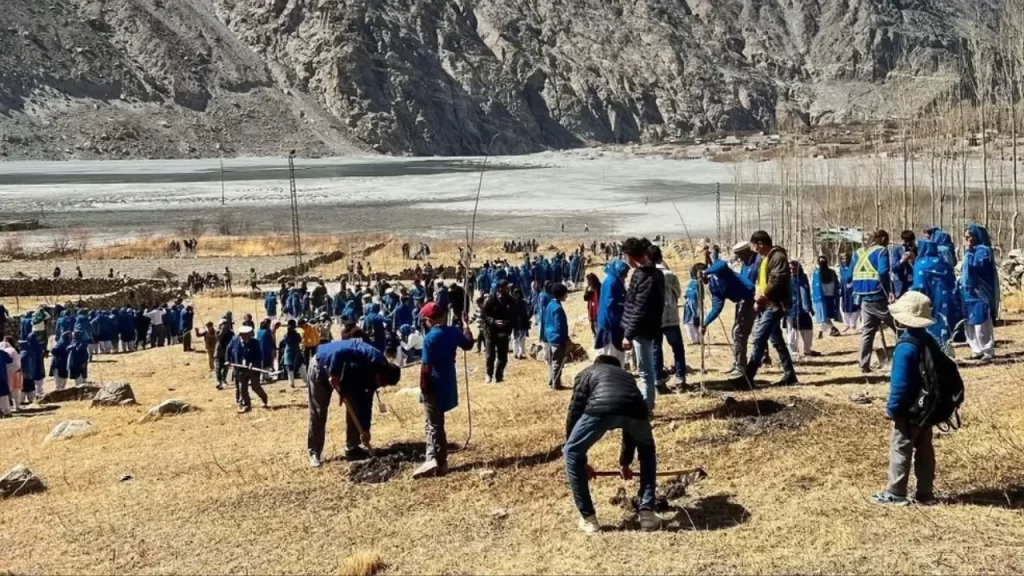
In personal terms, the people of Gilgit-Baltistan are determined to adapt without giving in to despair. Farmers are adjusting cropping calendars to the new water realities. Families are rebuilding homes on safer ground when possible. Children are being taught in school about emergency drills and climate awareness.
The tone in the mountains is one of urgent hope. A recognition that time is against us, but also that every degree of warming avoided, every flood prevented, and every life saved is worth the fight.
Governments and policymakers need to reduce emissions so temperature increase is controlled”. In that call, there is both a warning and a hopeful invitation for action.
Conclusion
In conclusion, the recent flash floods in Gilgit-Baltistan are a clarion call. They urge us to look at the melting mountains and rising waters and to respond with compassion, innovation, and resolve.
For the wider world, Gilgit-Baltistan’s floods carry lessons. They remind us that climate change is here now, not a distant threat, and it is hitting vulnerable regions hardest.
By learning from these events and supporting the solutions being forged on the ground, we can help ensure that the “Land of Glaciers” remains livable and thriving for generations to come – even as the climate continues to change around it. The journey ahead is challenging, but the spirit of the communities in northern Pakistan shows that constructive action is not just possible, it is already happening.
Their story is one of courage amid crisis, and it deserves not only our attention but our concerted global response.
Sources:
- Shah Meer Baloch, The Guardian – Accelerated glacial melt and monsoon rains trigger deadly floods in Pakistan (July 2025)theguardian.com.
- Al Jazeera – Pakistan issues glacial floods alert for northwest, heavy rain forecast (July 2025)aljazeera.com
- Aina J. Khan, New Lines Magazine – Pakistan Is Losing Its Glaciers to Climate Change (Jan 2025)newlinesmag.com
- Hamna Tariq, Columbia Climate School – Bridge Collapse in Pakistan Due to Glacier Lake Outburst Flood (May 2022)news.climate.columbia.edu
- IPRC Report – Pakistan 2022 Floods (Jan 2023)iprc.com.triprc.com.tr
- Associated Press (via ABC News) – Massive mudslide kills 7 volunteers repairing flood damage in northern Pakistan (Aug 2025)abcnews.go.com
- Wikipedia – 2022 Pakistan floods (Impact on Gilgit-Baltistan)en.wikipedia.org
- UNDP & Govt of Pakistan – Scaling Up of Glacial Lake Outburst Flood Risk Reduction in Northern Pakistan (Project Overview)adaptation-undp.org